Tango Technique

Why Balance Is the Foundation of Beautiful Tango?
Breathe Before You Move
Weight Transfer: The Most Important Skill
Intension
How to Pivot and why it's important to practice.

1. Why BALANCE is the Foundation of Beautiful Tango?
Beautiful tango does not begin with figures. It begins with balance.
Balance is the foundation that allows every movement to happen naturally, confidently, and without unnecessary effort.
When you know exactly where your body is in space, every step becomes clearer. You no longer search for stability—you already have it.
Balance gives us a stable position from which we can walk with confidence, remain present in every moment, and communicate clearly with our partner.
Without balance, every movement becomes a correction. With balance, every movement becomes a choice.
Balance Creates Confidence. Confidence in tango doesn’t come from knowing many figures. It comes from trusting your own body.
When you feel balanced, you stop worrying about falling, rushing, or grabbing your partner for support.
Instead, you become calm. Your posture becomes more natural. Your embrace becomes lighter.
Your movements become more elegant because they are no longer driven by fear of losing your axis.
Balance Creates Freedom
A balanced dancer has options:
You can pause.
You can accelerate.
You can change direction.
You can pivot with ease.
You can decorate the music naturally.
Without balance, these choices disappear because your body is constantly trying to recover stability.
One of the greatest gifts you can give your partner is your own balance.
When both dancers are responsible for their own axis, the embrace becomes comfortable and communication becomes effortless. Instead of holding each other up, you begin dancing together.
Balance Can Be Trained. Balance is not a talent. It is a skill.
Every dancer can improve it through simple daily exercises, greater body awareness, and understanding how the body organizes itself during movement.
Beautiful tango is not built on difficult figures.
It is built on simple movements performed with excellent balance.
Because when balance becomes effortless, everything else becomes possible.
A simple exercise:
Try This
Stand on one leg for 30 seconds.
Don’t try to stay perfectly still.
Instead, notice how your foot, ankle, knee, hips, and core work together to keep you balanced.
Now imagine bringing that same awareness into every step you dance.
Beautiful tango begins long before the first figure.
It begins with knowing where you are.

2. Breathe Before You Move
Over the years, I have realized that one of the most important parts of my dance isn’t a step, a pivot, or an embrace.
It’s my breath.
Breathing has become an essential part of the EK Tango System because it influences everything I do.
My breath helps me relax.
It shapes my emotions.
It deepens my musicality.
It keeps me connected with my partner.
It even changes the quality and direction of my movement.
Every breath creates a different possibility.
When I breathe naturally, my body feels lighter, more fluid, and more available to respond to the music and to my partner.
Sometimes I initiate a movement with my breath.
Sometimes my partner naturally joins that breath, and suddenly we are sharing the same intention before either of us has taken a step.
For me, this is one of the most beautiful forms of communication in tango.
That is why I believe breathing deserves its own practice.
Not only while dancing, but every day.
Breathing meditation, mindful breathing, and simple breathing exercises have helped me become calmer, more present, and more aware of my body.
Those qualities naturally appear in my dance.
The better I breathe, the more freely I move.
The more freely I move, the easier it becomes to connect—with the music, with my partner, and with myself.
For me, breathing is not separate from tango.
It is one of its foundations.
A Simple Practice
Every day, take a few minutes to simply breathe with intention.
Observe how your body expands as you inhale and softens as you exhale.
Notice how your posture changes, how unnecessary tension begins to disappear, and how your mind becomes quieter.
Then carry that same quality of breathing into your dance.
You may discover that your body already knows how to move—you simply needed to give it space to breathe.
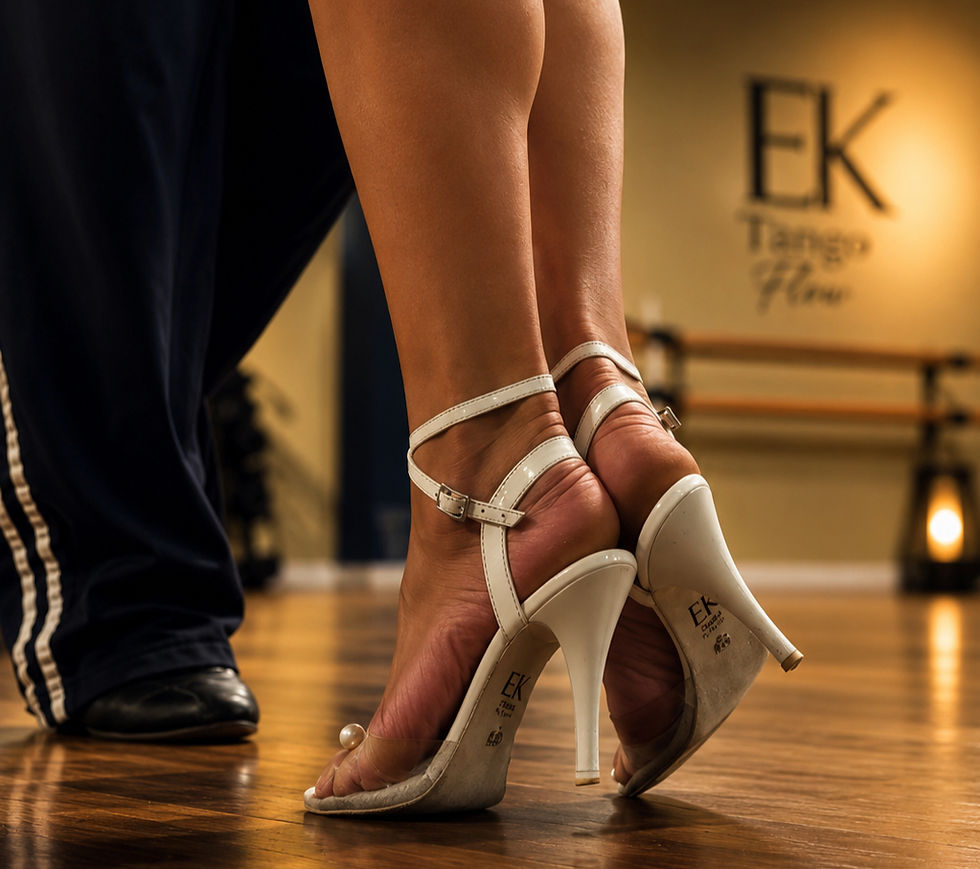
3.Weight Transfer: The Most Important Skill
In the EK Technique, that connection is called transition.
Transition is the bridge between one movement and another.
It connects step to step.
Figure to figure.
Pivot to walk.
Walk to pivot.
Without a good transition, dancing feels interrupted.
Every movement starts and stops instead of flowing naturally.
That is why weight transfer is one of the most important skills in tango.
It creates continuity.
It allows one movement to finish while preparing the next one.
When transitions become clear, dancing becomes smoother, lighter, and more efficient.
Another important part of every transition is the feet.
How we transfer our weight through the feet determines how easily we can continue into the next movement.
Most dancers know how to step.
Far fewer understand that there are different ways to transfer weight depending on the movement they want to create.
Each direction offers a different possibility.
Each transition creates a different solution.
That is why, in the EK Technique, we don’t practice transitions simply to move from one foot to the other.
We practice transitions to give ourselves more options.
The more options you have, the more freedom you have.
The more freedom you have, the more naturally you can adapt to your partner, the music, and the space around you.
Every beautiful dancer is constantly making transitions.
The difference is that they no longer think about them.
Their body simply knows how to connect one movement to the next.
Beautiful tango is not created by beautiful figures. It is created by beautiful transitions.
Three Simple EK Transition Practices
The purpose of these exercises is not to perfect a movement.
The purpose is to become aware of how your body transfers weight and creates smooth transitions.
1. Front-to-Back Awareness
Stand comfortably on both feet.
Slowly roll your body weight toward the front of your feet, then gently return toward your heels.
Move slowly.
Observe how your body changes with every small shift.
Notice where you feel most balanced and supported.
A good transition begins with awareness.
2. The Pendulum
Without taking a step, transfer your body weight from one foot to the other, like a pendulum.
Allow one leg to completely accept your weight while the other becomes light and free.
Avoid rushing.
The goal is not speed.
The goal is to clearly recognize the exact moment when responsibility changes from one leg to the other.
3. The Circle
Instead of moving only forward and back or side to side, imagine your weight drawing a small circle beneath your feet.
Explore every part of your feet:
the heel,
the inside edge,
the ball of the foot,
the outside edge.
Feel how your body remains balanced while your weight travels smoothly through each point.
This exercise develops sensitivity, stability, and a greater understanding of the many possibilities for transition.
A Final Thought
In the EK Technique, transitions are not simply a way to get from one movement to another.
They are an opportunity to create better balance, more freedom, and more possibilities.
The more consciously you transfer your weight, the more naturally your dance begins to flow.

4.Intension
Intension Before Figures
One of the biggest mistakes in tango education is teaching figures before teaching Intension.
A figure is simply a result.
Intension is the process that creates it.
Instead of asking:
“What step comes next?”
Ask yourself:
“How does my body organize itself to move?”
That single question changes everything.
Before the foot leaves the floor…
Before the free leg swings…
Before the embrace changes…
Your body has already made a decision.
Intension begins inside the body.
The feet simply reveal that decision.
This is why dancers who understand body organization appear calm and effortless. They are not reacting at the last moment. Their movement is already prepared before anyone can see it.
In the EK Tango System, we don’t begin with figures.
We begin with Intension.
Because when Intension becomes clear, every figure becomes easier.
The goal is not to memorize more.
The goal is to understand more.
When you understand movement, your body no longer searches for the next step.
It simply knows where to go.
Figures can be forgotten. Intension stays with you forever.
Master Intensiont first, and every step you dance will have purpose, clarity, and freedom.
Exercise: Experience the Sequence
Stand comfortably with your feet under your hips.
Don’t think about dancing.
Just observe.
Step 1 — Find the Space
Look in front of you.
Notice the empty space where you could move.
Don’t move yet.
Simply recognize that the space already exists.
Step 2 — Organize Your Body
Without taking a step, allow your body to organize toward that space.
Feel your standing foot connect to the floor.
Lengthen your spine.
Allow your weight to settle.
Notice that your body prepares itself before your foot moves.
Step 3 — Move
Now take one slow step into the space.
Don’t think about making a beautiful step.
Simply let your body move because it is already organized.
Step 4 — Pause
Stop.
Observe your new position.
You have just created a new space.
Now repeat the process in another direction.
What to Notice
Ask yourself:
Did I see the space before moving?
Did my body organize before my foot stepped?
Was the Intension easy or forced?
Could I feel that the step was a result, not the goal?
The EK Principle
Space comes first.Organization responds to space.Intension grows from organization.The figure is simply the visible result.

5. How to Pivot and why it's important to practice.
PIVOT
A pivot is one of the most useful tools in tango because it gives you options.
It helps you stay balanced.
It helps you choose a new direction without interrupting the flow of your dance.
It helps you adapt when there isn’t enough space.
It helps you recover when your movement isn’t exactly as you planned.
It helps you continue dancing when you don’t have enough energy to complete a larger movement.
A good pivot doesn’t just rotate your body.
It gives you another possibility.
The better your pivots become, the more freedom you have.
Freedom to change direction.
Freedom to adapt.
Freedom to stay connected with your partner.
Freedom to navigate any dance floor.
For me, this is why pivots are so important.
They are not simply a technique.
They are a decision.
They allow us to choose the best solution in every moment of the dance.
That is what I practice.
Not bigger pivots.
Better choices.
A Simple EK Pivot Practice
One of the easiest ways to develop better pivots is not by turning faster, but by becoming more aware of your balance.
Stand with your feet comfortably apart, about hip-width.
Without stepping, slowly rotate your body to the left and then to the right.
As you move, ask yourself:
Where is my body weight?
Which foot is supporting me more?
Does my balance stay centered, or does it drift?
Can I change direction without losing my stability?
Don’t rush.
The goal isn’t to make a bigger pivot.
The goal is to understand how your body organizes itself while changing direction.
The more clearly you can feel where your weight is, the easier it becomes to pivot with confidence.
In the EK Technique, a pivot is not just about turning.
It is about staying balanced while giving yourself the freedom to choose a new direction.
Practice awareness before practicing speed. A slow, balanced pivot teaches your body far more than a fast, uncontrolled one.


Comments